401k and IRA Alphabet Soup

Despite the tricky names, this topic can actually be simple. Let’s start with an easy breakdown of the two main retirement account types.

401k – This is a retirement account that you set up through work. You can only put money into a 401k account through payroll deductions (taken out of your paycheck before you get paid).

IRA – Individual Retirement Account. This is a retirement account that you set up yourself, not in conjunction with work. You can contribute to this any time and it doesn’t come directly out of your paycheck.

It’s important to know that there are also two different type of tax treatments for each of these accounts: Roth and Traditional. So, there are two different account types and two different tax treatments. This leaves us with 4 different account “styles” that we will address.

Traditional 401k – Pay through your paycheck. Save taxes this year.

Roth 401k – Pay through your paycheck. Save taxes at retirement.

Traditional IRA – Pay after you get your paycheck. Save taxes this year.

Roth IRA – Pay after you get your paycheck. Save taxes at retirement.

The difference between Traditional and Roth is how the taxes are handled. Short version: if it’s traditional, you get tax savings in the year that you contribute. If it’s a Roth, you save in taxes when you retire.

Longer version… stick with me. If this year you made $100,000 and contributed 10% to your Traditional 401k, that’s $10,000 right? Well, when you file your taxes for this year, you get to “deduct” $10,000 from your pay. This means that you don’t pay income taxes on that $10,000. So, if you’re in the 24% income bracket, you save this much: $10,000 x .24 = $2,400. Nice work! Not only did you set aside $10,000 for retirement, but you saved $2,400 in taxes! (This example ignores any other deductions etc. that might apply. It just shows the mechanics.)

Using the same numbers, if you contributed at the same rate to a Roth 401k, you do not get that tax savings when you file your taxes for this year. You’d still have to pay taxes on all $100,000 (Again, oversimplified example, but you get the idea).

The 401k is cool because you contribute money to it automatically through your payroll, so you don’t have to think about it and write a check or intentionally make a transaction every month in order to contribute. You go to your HR department (or online portal, etc.) and just plug in the percentage of your pay that you want to contribute per month (let’s just say 10%). From that point forward, your employer will automatically take 10% of your pay and send it off to your retirement account. Make $5,000 per month? You’ll automatically contribute $500 per month to your 401k. Simple. This is great if you don’t enjoy finance stuff because it can help prevent you from “forgetting” or investing “later.” It’s also cool because it saves money on you taxes. The third reason that makes a 401k cool (and probably the best aspect of it) is that lots of employers will chip in when you chip in. This is often called an employer “match”. This varies greatly by employer so you’re just going to have to check with your HR department. An easy example of a company match might be: your company will match your contributions, dollar for dollar, up to a 5% contribution. What does that mean? It means, if you make $100,000 and contribute 5% ($5,000) throughout the year, your employer will also put in $5,000. Lots of people consider this “free money” and recommend that you should contribute at least up to the point of your employer match. Huh? This means in our above example, if you only contribute $1,000, your employer also only gives you $1,000. That’s $4,000 “free” dollars that you don’t get. So if you are able, it would make sense to contribute at least $5,000 to get the $5,000 “free” dollars.

With an IRA, you contribute directly with money from your bank account. It doesn’t go straight from your paycheck like a 401k. You contribute to it whenever and however much you want (within the IRS limits, which was $6,000 per year in 2019). By contrast, you can contribute $19,000 to a 401k in 2019. An IRA can also help you pay less in taxes. It gives you another option to save for retirement. Let’s say your company doesn’t match or you’re doing a job that doesn’t have a 401k option. You can still set up an IRA. Generally speaking, if your company matches anything, it might be better to start with the 401k. If you have maxed out the 401k contributions, you can then also do an IRA.

Traditional vs Roth. Above, I gave an example of how someone who contributed $10,000 of their $100,000 paycheck to a traditional 401k wouldn’t have to pay taxes on that $10,000, right? And someone who contributed the same amount to a Roth would still have to pay taxes on their whole paycheck, right? Well, savers who use Roth accounts save at retirement. Their contributions are allowed to grow tax free and can be withdrawn and they pay no tax on any of it. Let’s say someone does a one time contribution of $10,000 to a Roth IRA. Then they forget about it and remember when they turn 59.5 years old. Hypothetically, many years have passed and it grew to about $80,000. They get to take that all out and don’t pay any taxes. Meanwhile, their buddy who used a traditional IRA, has to pay taxes on all of his earnings when he withdraws it. He got his tax break years ago when he filed his return that year.

Easy version: if your retirement is soon, a traditional IRA is typically better. If you’re retiring long into the future, a Roth is typical going to to result in a higher total.

Easy examples: Let’s say that you decide to open a traditional IRA. You would do this by calling the brokerage house of your choice (Vanguard, Fidelity, Schwab, etc.) and they’d be happy to help. Now the account is open and you contribute the maximum for 2019 which is $6,000. If you made $100,000 this year, you get to deduct the $6,000 and you only pay taxes on the remaining $94,000 (assuming you have no other deductions, which is not the case but it’s easier to understand the mechanics this way). The tax rate on those $6,000 would have been 24% but since you contributed those dollars into your traditional IRA, you don’t pay the taxes on that money that year. (Depending on what other deductions you have, you may not be in the 24% tax bracket, but let’s just keep things simple, please.) Back of the envelop math:

$100,000 – $6,000 = $94,000. Then, $6,000 x .24 = $1,440. You saved yourself $1,440 on your taxes this year! Nice work. Important note: when you retire, you will have to pay taxes on the earnings when you take it out, including any growth that you enjoyed. Please keep in mind, this example was for an IRA that you set up on your own. The math is the same for the 401k. The only difference is how you contribute.

Roth IRA example. Your friend, Becky, decides she’s going to set up a Roth IRA the same day that you open your IRA. Interestingly, she also makes exactly $100,000. Weird. She writes a check for $6,000 and sends it into her brokerage, but when she files her taxes, she doesn’t get to subtract that $6,000! Not fair! This is because she contributed to a Roth IRA. The tax savings on Roth accounts comes at retirement. Between now and when Becky retires that $6,000 (and any other contributions that she makes) grows and grows, right? Well, when she takes that money out, Becky doesn’t pay tax on any of it! Given that Becky made the maximum contributions and started early, this could be hundreds of thousands of dollars, or more.

Back of the envelope math. The assumptions are a 30 year old contributes $6,000 at a 10% rate of return and never contributes again. Then retires at 65. The 65 year old is left with $168,614.62. She can take that out and pays no tax. Jackpot!

But what do I put into my 401k or IRA? Whatever you want, generally. Most people stick with a basic S&P 500 Index Fund or something similar. Although, you could just buy one stock and put it all in that. Same with the Roth. For semantics, you don’t truly invest in an IRA or 401k. They are simply accounts which hold your investments. You put money in these accounts and then invest in assets like index funds with the money once it’s in there.

Think of the these accounts like umbrellas. You can put whatever you want underneath them. Stocks, bonds, mutual funds, index funds. Some people even get more creative than that, but we’re keeping it simple. Just know that anything under the umbrella gets a tax benefit.
I Am Moving. Should I Sell My House or Rent It Out?

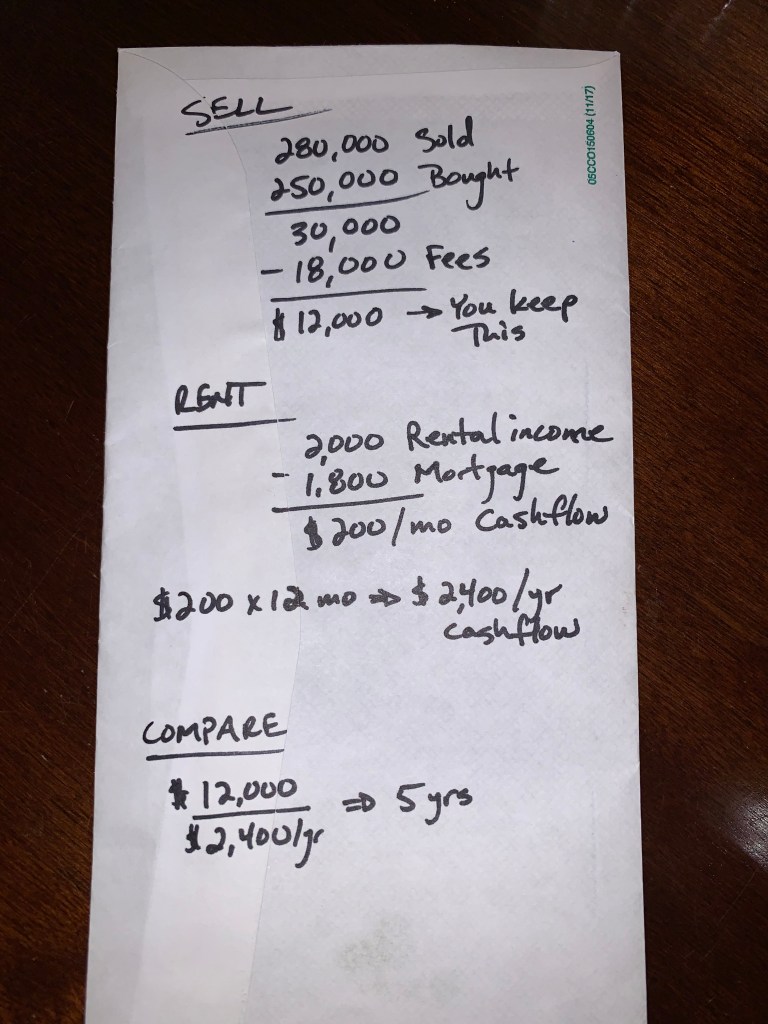
So, despite my best efforts, there is still some complexity within a lot of the financial decisions discussed in this blog. However, this one is one of the easier choices to explain. The math is simple and is truly Back of The Envelope.

First, a few assumptions…

1 – You need to be able to get a mortgage for the second house. The bank may make your decision for you and tell you that you don’t qualify for another mortgage without selling your house. If so, there’s no choice to make!

2 – The house in question is worth more than what you paid for it. This is not a requirement to rent or to sell your house. But for this exercise, that’s what we are going to assume.

3 – Lots of the fees, repairs, and management expenses are either roughly approximated or ignored. We could really get lost in the details in this article if we discussed all of the “what ifs.” You’ll need to look at your specific situation for the details. We are just looking at the mechanics of what numbers to look at.

Ok, so here’s my thought: look at how much money you would make by selling your house. Then, find out how much money you would make by renting it. Compare those numbers and your choice might become very clear. But how?

Selling. Let’s say you bought a house for $250,000 a few years ago and you think you could reasonably sell it for $280,000. $280,000 – $250,000 = $30,000. The real estate agents have to buy groceries (to the tune of about 6% of the transaction value, which is $16,800 in our case) so you need to take those costs away from your profit. Let’s round that up for extra bank fees, inspections, title paperwork etc. to $18,000. This is a gross approximation but we’re just looking at the mechanics, not the specifics. In reality, you will need to find out exactly what it will cost you to sell the house because you need to know exactly what you will be walking away with afterwards. For this example, $30,000 – $18,000 = $12,000. That is your “profit” if you sell your house. Not bad.

Renting. You need to take a really close look at your community and the rental market in your immediate vicinity. Down to the neighborhood. If you are in a building of condos, this should be fairly easy because there are probably several other units that are the same size and shape as yours. What do they rent for? Are they in similar condition? If you’re in a house, you can look to see what other houses with the same number of bedrooms and bathrooms rent for. Make sure you’re looking at houses that would be in the same school districts, etc. The closer the better, but they also need to be very similar. What would your place rent for? Let’s say our imaginary house would rent for $2,000. Nice round number. The next number we need is one that you already have. Your monthly mortgage payment, including taxes and insurance (these vary greatly by state and region). Basically, what amount do you pay the bank every month? For our purposes, we will use $1,800.

Now the math. You find out how much money you’d make each month:

$2,000 (rental income) – $1,800 (mortgage payment) = $200 (this is often called “cash flow”). Now, that is only one month. Let’s multiply it by 12 to find out how much money we’d make in a year. $200 x 12 = $2,400. So, you would have put $2,400 in your pocket at the end of the year. (Note: this example ignores any management, maintenance, or any other costs associated with the property other than the mortgage. We’re keeping our example as simple as possible.)

Now we have two good numbers: $12,000 if we sell the house and $2,400 per year if we rent it. Got it? Now, I would suggest that you figure out how many years of renting would it take for you to equal the money you would make just by selling it? The math on that is: $12,000 / $2,400 = 5 years. Simply put, it would take you 5 years of perfect renting with no vacancies or repairs to make the same amount of money you could make by selling it next month. I won’t say which is right or wrong, but now you have some tangible numbers to compare rather than just thinking about it emotionally.

Some extra things to thing about.

  • We didn’t, but you should definitely plan for some maintenance and repair costs, especially over a 5 year period like the one we discussed. Have you ever lived somewhere for 5 years? Did you go all 5 years without a single repair or maintenance cost? Unlikely. This must be factored into your cashflow calculation.
  • You need to either plan to spend some money on a management company or plan to do this stuff yourself. Often, rental management or lack thereof is the difference between making money and not making money. It is not cheap. It must also be factored into your cashflow calculation.
  • Above, I described the monthly profit as “cash flow.” It is important to recognize that there are other ways to benefit from keeping the house and renting it. For instance, while you collect rent checks and then pay your mortgage, you are paying off your principal. This is called equity. Basically, you will own more and more of the house as you pay off more principal – which is outside the scope of this article, but important. Also, depending on your tax situation, keeping the house and renting it out can benefit your tax bill. One thing to look up if you’re interested is “depreciation”.
  • Please understand that I am simply trying to explain the mechanics of how to view this choice. For instance, I suggest that you figure out what your potential cashflow would be. I am not telling you how to find it. It’s very important to figure out what your specific numbers (cashflow vs. sales proceeds) would be before you compare them.
  • There are many other reasons that this choice could be complicated. Are you moving out of state? Do you want the equity from house #1 in order to have a large down payment? Do you just not want to “deal with it”? The above example is just a quick back of the envelope math to help provide one data point in your decision-making.

The Market? I’ve Heard of it.

“I want to invest in the market but I don’t know if I should start with an index fund or the S&P 500.”

What in the world did this person just say? And does it make sense? Want the answers to these questions? Keep reading.

Some of the terms in finance can be intimidating. I imagine this is by design. Let’s start with the basics.

The Market, S&P 500, Index, Fund.

The “market.” This can vary depending on context but generally, when people in the finance world mention the market, they are referring to the collection of all publicly traded companies, typically in the United States. What is a publicly traded company? It’s a company that you can buy or sell a share of. If you can’t buy or sell a share of it, it’s private. Easy example: Starbucks is public. The local coffee shop down the street is probably private. Generally speaking, if it’s a big company that you have heard of, it’s probably a publicly traded company. Even some big companies that you haven’t heard of are public. Amazon, Apple, Netflix. All publicly traded companies. Your neighbors dog walking company, your cousins plumbing business. Both private. Make sense? There are some, but not a lot, of big companies that are private. One such outlier is Chic-fil-a. It’s big but it’s private. You cannot buy a share of Chic-fil-a like you can buy a share of McDonald’s.

So, like we mentioned above, “the market” can vary by context. But it typically means: all of the stocks. Some companies are big and some are small, right? We call the size of a company an intimidating term called “market capitalization” or “market cap.” The bigger the company (in terms of total value), the higher the market cap. Ex: Apple has a higher market cap than Home Depot. How do I know that? I looked it up. And for this level of discussion, it just doesn’t matter. If you are looking for the easiest way to invest in “the market”, you’re going to buy all of them anyways. We’ll get to that. Another similar term for “the market” is the S&P 500. “I’ve heard of that but what is it?” It is a list, or “index”, of the 500 companies in the United States that have the highest market caps; the 500 biggest publicly traded companies. It’s literally just a list and what’s important is that you don’t have to worry about every company that is on that list. It’s just the 500 biggest companies. Wal-Mart, Apple, Target and 497 of their biggest friends. When you “invest in an S&P 500 index fund” you’re buying a small piece of all 500 companies. Whoever you buy it through (Vanguard, Fidelity, etc.) does all the math for you.

If you’re still with me, we can look further down the rabbit hole… What about the smaller companies? The 501st biggest company is not included in the S&P 500 index. Nor are the next several thousand companies. “The market” can also include all of these smaller companies. These are also publicly traded companies but, because they are smaller, they generally get less attention. These would NOT be in the S&P 500 but would fall into a “Total Stock Market Index.” For our purposes, the “market” can just mean, the S&P 500. It doesn’t include every publicly traded company, but it has all of the big ones. It’s a simplification, but it’s a common one.

Index fund? Index = list. Fund = pool of investor money. So, an index fund is just a pool of money that you contribute to and the fund manager (Vanguard, Fidelity, etc.) buys shares in that list of companies. The easiest example is an S&P 500 index fund. When you buy a share of this, you’re investing in all 500 of the biggest companies in the U.S. This is indiscriminate and requires no choices on your part. If a company is on the list, you’re buying it. If it’s not, you’re not. Important note: an S&P 500 index fund from Vanguard is essentially the same thing as an S&P 500 index fund from Fidelity, or any other brokerage house. Those in charge of these funds, or the “fund managers,” simply take your money and allocate it according to the list. Simple as that. The opposite of an index fund would be an “actively managed” mutual fund. These fund managers have a more difficult job. They do not just buy all 500 of the biggest companies. They try to outsmart everyone by only buying specific companies that they think will do well and they don’t buy others because they think they will do poorly. It’s important to note that it’s very difficult and typically rare for actively managed funds to beat “the market” or “the S&P 500.” They are also more expensive. Expensive? Every fund has a fee that they charge. They take it out of your balance every year and for index funds, it’s generally very low. Let’s say a quarter of a percent or less. So for every $1,000, you’d pay about $2.50 per year. Actively managed funds are generally much more expensive and can be well over 1% or higher. That extra percent can really matter in the long run due to the power of compounding. See this post if you’re curious how small amounts early on can result in big returns later:

https://bote.finance.blog/2019/11/25/compound-interest-and-the-rule-of-72/

So, to review… the market is all of the stocks. An index is a list of stocks. It could be 500 or it could be more, or even less. It’s just a list. The S&P 500 is just a specific list. It’s a list of the 500 biggest American companies. An index fund is something that you can buy and it will disperse your money according to that list, indiscriminately.

Compound Interest and the Rule of 72

Every $1,000 you save today could be worth $64,000 at retirement. Although I’m certainly not immune to typos, the previous sentence doesn’t have any. I double checked.

You have likely heard of compound interest before. The general idea is this: you earn interest on your previous years interest; so each year, you progressively earn more and more interest.

https://bote.finance.blog/2019/11/25/the-market-ive-heard-of-it/

Some examples to encourage you:

You are 35 years old and have $5,000 today in a S&P 500 index fund (This is what I mentioned above. Don’t let the name scare you). We will assume that it will earn 10% per year (again, not guaranteed but historically, this is pretty close). You plan to retire in 30 years at 65 and you don’t put in another dime. At 65, you’ll have $87,247.01. This is more than 17 times your original value of $5,000.

Keep in mind, the earlier you put money in, the more time it has to accumulate via compound interest. Also keep in mind that the above example assumes that you started with $5,000 and never added to it. Another way to make your total grow is to periodically add to your growing balance. Let’s say you save your tax returns and add $1,000 to your account every year until you are 65. The total you would have at retirement would be $251,741.03, more than 50 times your starting value.

A few more examples based on the 35 year old mentioned above who plans to retire at 65:

  • You start with $10,000 –> By retirement at 65: $174,494.02
  • You start with $15,000 –> By retirement at 65: $261,741.03
  • You start with $50,000 –> By retirement at 65: $872,470.11

Now, let’s see how our 35 year old does after adding $1,000 per year in the above examples.

  • You start with $10,000 –> By retirement at 65 (+$1,000/year): $338,988.05
  • You start with $15,000 –> By retirement at 65: (+$1,000/year): $426,235.06
  • You start with $50,000 –> By retirement at 65: (+$1,000/year): $1,036,964.14

It’s very important to recognize that this person has 30 years of compounding to achieve those balances.

If our above investor waited until they were 50 to start investing, the retirement balances would be shockingly lower. If a 50 year old started with $15,000 and retired at 65, his or her balance would be $38,906.14. Not a small sum, but hardly the $262,741.03 that the younger investors will enjoy. The earlier you start, the better.

“But I will just wait until I’m older and making more money. Then I’ll be able to save more!” Although this sounds like a good plan, the power of compounding shows that it will not be nearly as effective to save more later down the road. Even if our 50 year old got a raise and was able to add $5,000 per year on top of the initial $15,000, the total at 65 would still only be $118,593.26. This is about $80,000 less than the 30 year old who started with $15,000 and never added a cent!

A lesser known term is the Rule of 72. This is a simplification of compound interest which leads you to a rough idea of how long it will take for your money to double. Let’s use our above example to illustrate: You have $1,000 saved at 10% and want to know how long it will take to become $2,000. The easy back-of-the-envelope math is: 72 divided by the annual percentage rate, or 72/10=7.2 in our case, 7.2 years. This assumes a consistent annual interest rate. It may be an over-simplification but it will give you a general idea of where your money stands.

Let’s follow our example back to the beginning. Assuming a 10% annual rate of return, 72/10 gives us 7.2 years until our money doubles and becomes $2,000. So, every 7.2 years, our money should double. We can exercise the Rule of 72 again to find out how long it will be until our $2,000 doubles. At about 14.4 (7.2 x 2) years, we will have $4,000. Following so far? 21.6 (7.2 x 3) years go by and we have $8,000 and so on. Following this progression where our money doubles every 7.2 years, with an initial investment of $1,000 and a growth rate of 10%, at just over 43 years, we’ll have $64,000. So, if you’re in your early 20s and can afford to put away a few thousand dollars and forget about it for 40 years or so, you should be sitting pretty!

Design a site like this with WordPress.com
Get started